본문 바로가기 주메뉴 바로가기

IBS
Yemilab Operation Center

  • About Yemilab
    • History of Korean underground laboratory
    • Organization
    • Location
    • Contributions
  • For Visitor
    • General announcement
    • How to come
  • For User
    • LoI format
  • Research
    • Particle physics
    • Nuclear physics
    • Radiation technology
    • Others
  • Publication
    • Journal
    • Youtube
    • Newspaper
  • Events
    • Sindong Science drawing contest
    • Underground Science school
사이트맵 전체메뉴 열기
Home Research Nuclear physics Rare decay
Print Page

Research

  • Particle physics
    • Dark matter
    • Neutrino
    • Others
  • Nuclear physics
    • Rare decay
    • Astrophysics
  • Radiation technology
  • Others
    • Geology
    • Environmental radiation
    • Biology
    • Seismology

Rare decay

Search for forbidden beta decay of 50V using 14ch array HPGe

  • The search for extremely rare events is one of the interest topic in nuclear particle physics.
  • 50V is one of the isotopes which exhibit fourfold forbidden non-unique transitions (ΔIΔπ= 4+)
  • It is very highly forbidden, allowing only fourfold forbidden non-unique decay modes into the first excited states of 50Cr and 50Ti (6+ → 2+ transitions).
  • Higher detection efficiency using 14ch HPGe (70% each, ~1,000% total)
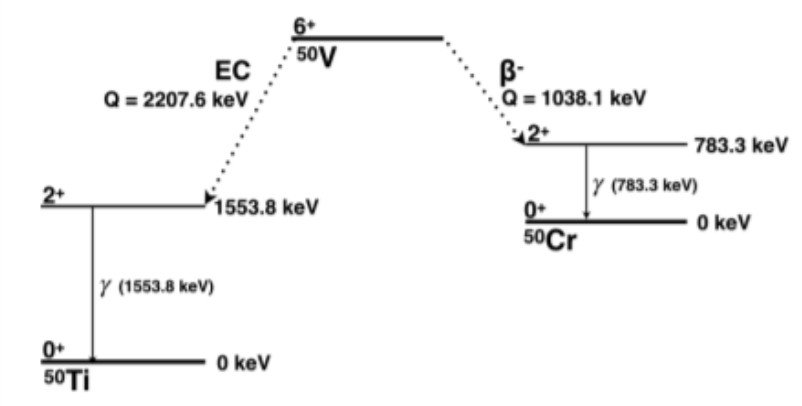
  • An energy level diagram showing the fourfold forbidden decay process of Vanadium-50 (50V) into Titanium-50 (50Ti) and Chromium-50 (50Cr).
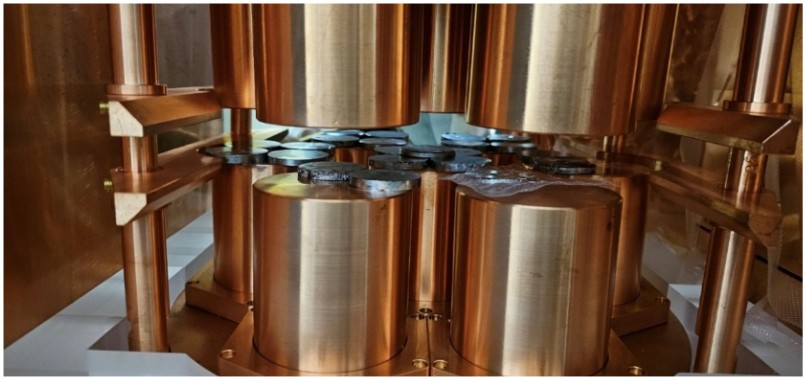
  • A photograph of the experimental setup showing sample disks placed on top of the copper High-Purity Germanium (HPGe) detector cylinders.
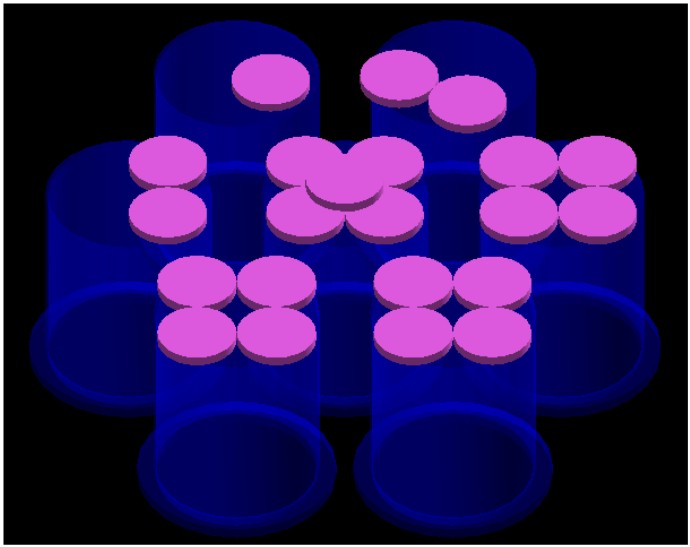
  • A 3D model visualizing the arrangement of multiple sample disks on top of the High-Purity Germanium (HPGe) detector array.
Back to top
IBS
Yemilab Operation Center
주소
211, Hambaek-ro, Sindong-eup, Jeongseon-gun, Gangwon-do, Republic of Korea
Copyright IBS Yemilab at IBS. All Rights Reserved.