
The Center for Genomic Engineering (CGE) consists of twelve constantly evolving, independent research teams. The core lab of the center is led by CGE Director Dr. Bon-Kyoung Koo and comprises the Koo Lab and the core facilities team. The other research teams are led by promising early-career scientists, including adjunct scholars from top-tier universities in South Korea, research fellows, and senior researchers.
CGE encourages its individual labs to set bold yet feasible goals and to actively cooperate with one another, creating a research-focused environment that is both friendly and professional. We aim to build a ‘research playground’ at the Institute for Basic Science (IBS), which offers a firm and stable support system for both Korean and international junior scientists, allowing them to become highly successful academic leaders in basic research.
More specifically, our work consists of the following:
1. We are developing novel genome editing tools—such as Zinc Finger Nucleases (ZFNs), Transcription Activator-Like Effector Nucleases (TALENs), CRISPR/Cas-based nucleases, and base editors—for application across various species. Dr. Annie Kim leads CGE’s genetic engineering tools team. Additionally, research fellow Dr. Ji-Hye Yun leads the Structure team, which utilizes structural biology to advance the development of these gene editors.
2. Our diverse teams, led by our adjunct scholars, apply these genetic tools to a variety of organisms. Prof. Ho-Seok Lee (Kyunghee University), Prof. Eunyu Kim (Kyunghee University), and Prof. Donghwan Shim (Chungnam National University) specialize in plant genetics. Dr. Jung-Hwa Choi, our resident fish expert, heads the fish genetics program. Furthermore, Dr. Bon-Kyoung Koo’s team studies a wide range of species by establishing an Organoid Zoo.
3. We are developing and actively employing conditional knock-out (SCON) and knock-in (ICON) platforms. These projects of the Koo lab aim to improve genetic tools to answer significant biological questions through research in mice and organoids. They also leverage the mosaic genetics developed by their lab to investigate the early stages of tumors and aging.
4. We are heavily invested in exploring stem cell biology, an effort spearheaded by our adjunct scholars. Prof. Jihoon Kim (Catholic University), D.D.S./Ph.D. Eunae Sandra Cho (Yonsei University), Prof. Hee Seung Lee (Yonsei University), and CGE research fellow Dr. Ji-Hyun Lee are conducting independent research projects to advance the stem cell field in various organs.
5. The bioinformatics team, led by Dr. Heetak Lee, provides computational insights for all the aforementioned projects. They pursue their own independent research goals while actively cooperating with other experimental teams to address complex biological questions.
Research Highlights
Our research focuses on developing innovative genetic engineering technologies while uncovering fundamental mechanisms that regulate tissue homeostasis, regeneration, and disease. Below are three recently published papers by our lab to showcase the recent advancements.
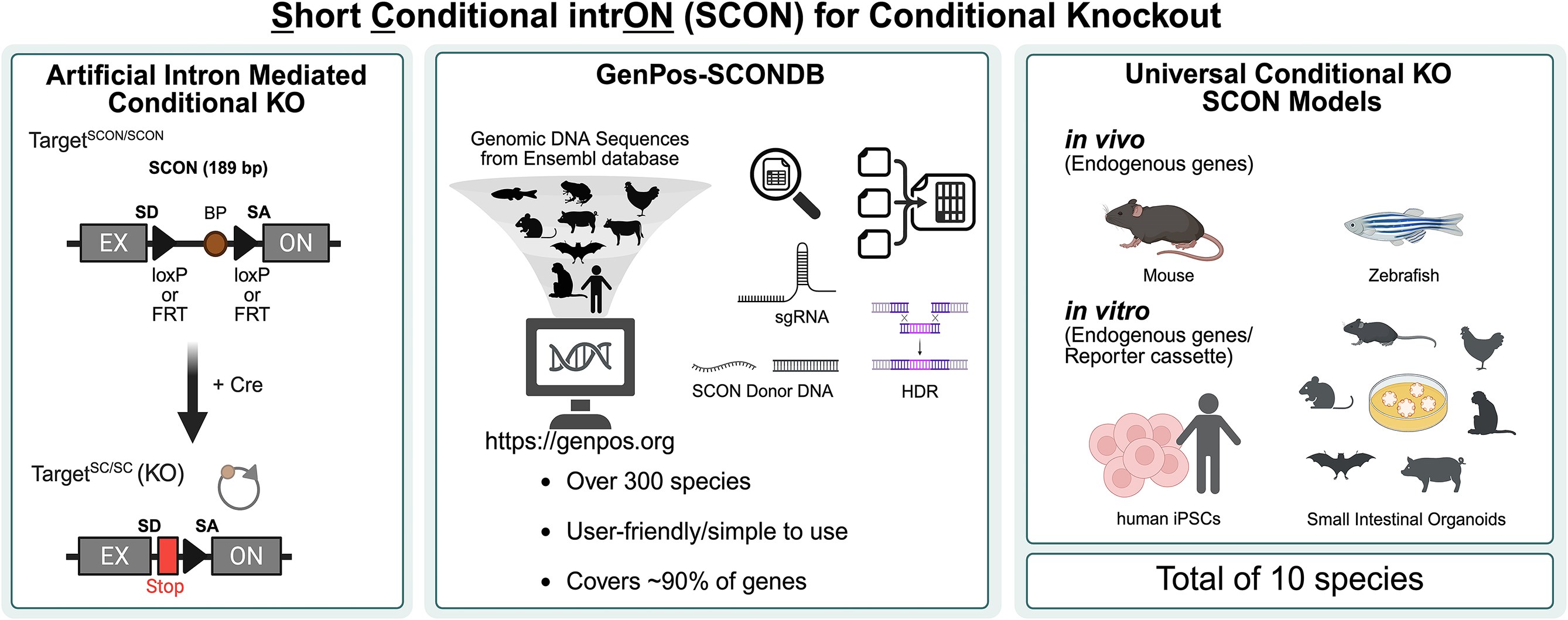
Universal conditional knockout approach to multiple species, from fish to human induced pluripotent stem cells (2026, Nucleic Acids Research)
Conditional gene knockout strategies have revolutionized functional genetics in mice but remain difficult to establish in most other model organisms and cell systems. In this study, we present a universal conditional knockout strategy that extends conditional genetics across a broad range of vertebrate species, from zebrafish to human induced pluripotent stem cells. Using the previously published, compact SCON cassette and CRISPR-mediated genome editing, we demonstrate efficient generation of conditional alleles in diverse biological systems while maintaining normal gene function prior to recombination and robust gene inactivation following Cre-mediated excision. By overcoming a major technical barrier to conditional genome engineering outside of traditional mouse models, this platform provides a broadly applicable strategy for studying gene function, modelling disease, and developing genetically engineered cellular and animal models across species.
DOI: 10.1093/nar/gkag480
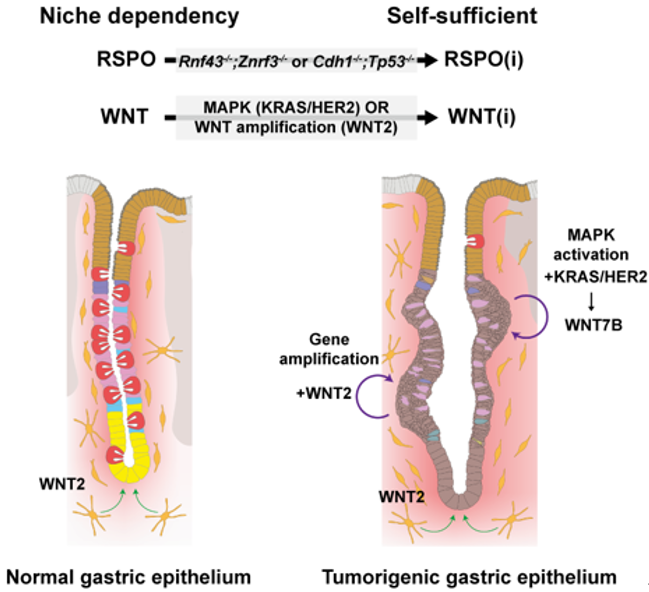
Epithelial WNT secretion drives niche escape of developing gastric cancer (2025, Molecular Cancer)
Gastric epithelial stem cells depend on WNT signals provided by their surrounding niche to maintain tissue homeostasis. Unlike colorectal cancer, gastric cancer rarely acquires mutations that activate WNT signalling independently, leaving the mechanism underlying niche escape unresolved. In this study, we demonstrate that oncogenic KRAS reprograms gastric epithelial cells to produce their own WNT ligands through activation of the MAPK–SMAD2/3–WNT7B axis, allowing developing tumours to become self-sufficient for WNT signalling. Using genetically engineered mouse models, organoids, single-nucleus multiomic analyses, and patient-derived gastric cancer organoids, we show that this mechanism is conserved in human disease and represents a therapeutic vulnerability, as tumour growth remains dependent on WNT secretion. These findings reveal a previously unrecognized route by which gastric cancers escape their stem cell niche and establish autonomous growth.
DOI: 10.1186/s12943-025-02543-z
