
Seminars & Events
Highlight
POSTECH Professor Dong Sung Kim Engineers Biophysical Niches for Organoid Maturation and Morphogenesis
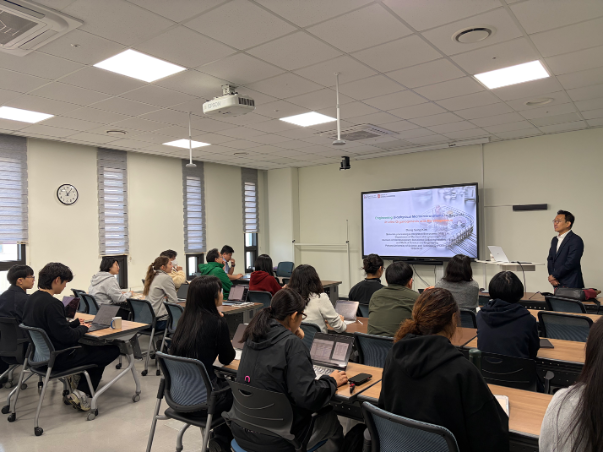
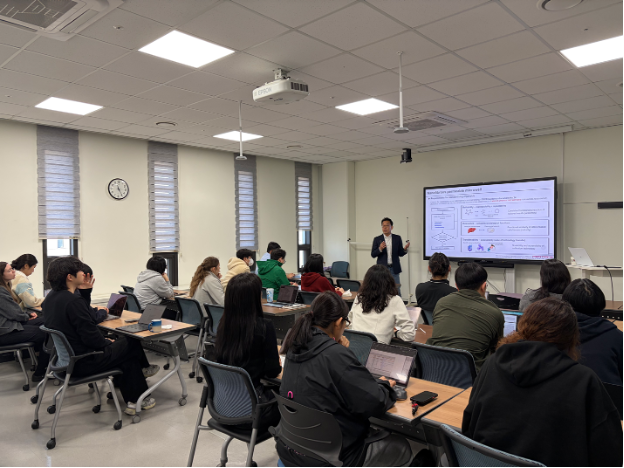
On April 7, the Center for Genome Engineering at the Institute for Basic Science hosted Professor Dong Sung Kim of POSTECH for an internal seminar titled “Engineering Biophysical Microenvironments to Regulate In Vitro Organogenesis and Morphogenesis.”
Professor Kim’s group combines polymers, hydrogels, and microfabrication to build microphysiological systems in which cells experience tissue-like mechanics and transport. Conventional culture plastic is much stiffer than most organs and poorly reproduces stretch or molecular exchange. The seminar focused on permeable nanofibrous membranes designed to overcome these limitations.
A Thin, Stretchable, and Permeable Tissue Interface
The NaRE membrane consists of collagen nanofibrils covering a supportive nanofiber scaffold. It combines pores with mechanical stability, enabling long-term culture and repeated stretching. Incorporated into culture inserts or microfluidic chips, it can reproduce barrier tissues while allowing cells on opposite sides to exchange signals.
The platform has been used to observe inflammation-dependent T-cell infiltration and to model the blood–brain barrier with iPSC-derived brain microvascular endothelial cells. Changes in permeability as endothelial barrier function develops can be measured directly.
Uniform and Mature Organoids in Permeable Microwells
Impermeable microwells restrict oxygen and nutrient delivery and can leave dead cells inside spheroids and organoids. The team developed the NOVA microwell by three-dimensionally shaping a nanofibrous membrane, maintaining uniform aggregate size while increasing molecular exchange.
The subsequent UniMat platform extended this principle to hiPSC-derived kidney organoids. Organoids grown on the permeable membrane were more uniform and displayed improved vascularization and maturation. Single-cell transcriptomic analysis also showed a cellular composition closer to kidney tissue, supporting more reproducible disease modeling and drug testing.
From Culture Platforms to Tissue Morphogenesis
Professor Kim also presented 3D-bioprinted artificial muscle wrapped in nanofibers and an automated culture system combining perfusion-based medium exchange with optical monitoring. Another line of work engineers the wrinkle-to-fold transition of epithelia to reproduce folded structures found in the airway, intestine, and stomach.
The seminar highlighted that stiffness, curvature, and permeability can shape development as strongly as soluble factors. Precisely engineering these physical conditions may standardize organoid quality and create experimental models that better reproduce organ structure and function.
Toward Reproducible Organoid Manufacturing
Permeability is only one part of the organoid challenge. Researchers must also obtain tissues of comparable size and quality from one experiment to the next. Matrigel-based cultures often produce organoids at irregular positions and sizes, increasing variability in imaging and dose-response studies. A permeable microwell collects cells within a defined geometry while supplying oxygen and nutrients from below, allowing many uniform organoids to be produced in parallel.
The team also introduced an image-based artificial-intelligence model that estimates the proportion of nephron progenitor cells and predicts whether a differentiation batch is likely to succeed. A conventional marker assay can verify cell identity but sacrifices the tested cells. Non-destructive prediction from culture images could instead guide decisions during differentiation and reduce the time and cost spent on unsuccessful batches.
These platform concepts have been translated into Celloid’s NestWell product and the OrgaNest system, which combines perfusion-based medium exchange with optical monitoring. Standardized cultureware, automated feeding, and longitudinal imaging could turn laboratory organoid protocols into reproducible manufacturing processes. Such control will be particularly valuable for patient-derived organoid drug screening and toxicity testing.
References
Kim, D., et al. (2024). Scalable production of uniform and mature organoids in a 3D geometrically-engineered permeable membrane. Nature Communications, 15, 9420.

- 55, Expo-ro, Yuseong-gu, Daejeon, South Korea, 34126 Tel. +82-42-878-8310
Copyright(c) 2022 Center for Genome Engineering Research at IBS. All Rights Reserved.