
Seminars & Events
Highlight
SNU Professor Pil Joon Seo Identifies Cellular and Hypoxic Barriers to Plant Regeneration
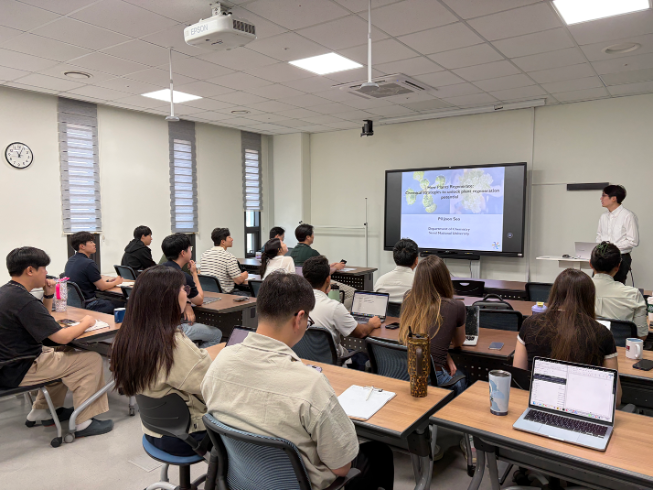
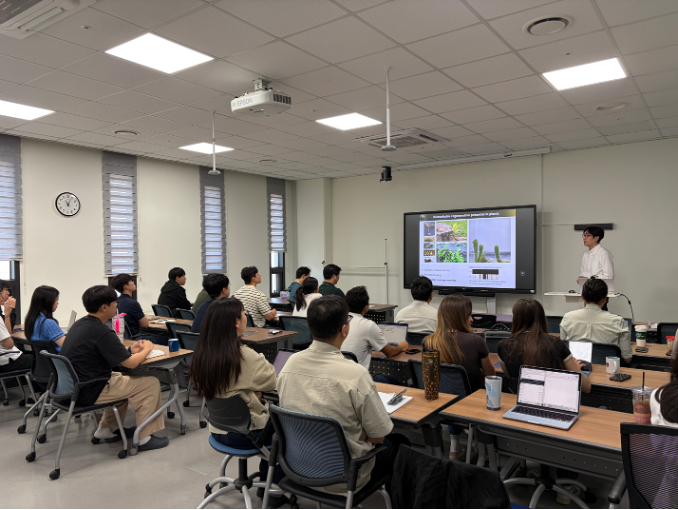
On June 12, the Center for Genome Engineering at the Institute for Basic Science hosted Professor Pil Joon Seo of the Department of Chemistry at Seoul National University for a seminar titled “How Plants Regenerate: Chemical Strategies to Unlock Plant Regeneration Potential.”
Plants can generate callus from injured tissue and regenerate new roots or shoots, but calli produced under the same conditions do not necessarily retain equal regenerative competence. Professor Seo’s group uses transcriptomic and single-cell approaches to determine how cell states change after hormone treatment and which intrinsic barriers reduce pluripotency.
Calli That Look Alike but Behave Differently
Leaf explants form callus on auxin-containing callus-inducing medium. The team observed that longer incubation on this medium reduced subsequent shoot regeneration, even when pluripotent and non-pluripotent calli were difficult to distinguish by appearance or average transcriptomes.
Single-cell RNA sequencing revealed shifts in cell-type proportions over time. Accumulation of lateral-root-cap-like cells and reactive oxygen species correlated with loss of regeneration competence. Callus is therefore not a static mass of undifferentiated cells but a tissue that continues to change state.
A Hypoxic Barrier Created by Cell Proliferation
Rapidly proliferating callus establishes a hypoxic microenvironment. RAP2.12, an ERF-VII protein stabilized under low oxygen, increases salicylic-acid biosynthesis and defense responses, thereby suppressing pluripotency acquisition and de novo shoot formation.
The 2024 Molecular Plant study identified the RAP2.12–SID2 pathway as the link between proliferation-induced hypoxia and reduced regeneration. Modulating oxygen supply or the hypoxia response may therefore preserve regenerative competence.
Molecular and Metabolic Strategies for Regeneration
Professor Seo also discussed morphogenic regulators such as GRF–GIF chimeric proteins, which improve transformation and regeneration in multiple crops. Considering amino-acid depletion and other metabolic states alongside gene expression may uncover additional causes of regeneration failure.
Plant genome editing is complete only when an edited cell can regenerate into a whole plant. The seminar showed that coordinated control of callus composition, oxygen, reactive oxygen species, hormones, and metabolism may improve genome engineering in regeneration-recalcitrant crops.
Removing the Regeneration Bottleneck in Plant Genome Editing
Plant genome editing depends not only on changing the target DNA accurately but also on regenerating edited cells into shoots and roots that transmit the edit to the next generation. Tissue-culture responses differ widely among crops and even among cultivars, so identical CRISPR reagents can yield very different numbers of complete edited plants.
Professor Seo’s work shows that prolonged callus proliferation on callus-inducing medium is not necessarily beneficial. Cell number increases, but hypoxia and reactive oxygen species accumulate, and the proportion of regeneration-incompetent states rises. A successful protocol must therefore balance expansion of edited cells with preservation of pluripotency.
The seminar also considered chemical approaches that complement morphogenic regulators such as GRF–GIF. Adjusting amino-acid availability and the molecular environment of regulatory proteins may lower regeneration barriers without persistent transgene overexpression. Identifying the cell populations in which failure begins and reversing those states through coordinated control of oxygen, hormones, and metabolism could broaden precision breeding and genome editing in recalcitrant crops.
References
Koo, D., et al. (2024). Callus proliferation-induced hypoxic microenvironment decreases shoot regeneration competence in Arabidopsis. Molecular Plant, 17(3), 395–410.
Debernardi, J. M., et al. (2020). A GRF–GIF chimeric protein improves the regeneration efficiency of transgenic plants. Nature Biotechnology, 38, 1274–1279.

- 55, Expo-ro, Yuseong-gu, Daejeon, South Korea, 34126 Tel. +82-42-878-8310
Copyright(c) 2022 Center for Genome Engineering Research at IBS. All Rights Reserved.