
Seminars & Events
Highlight
Dr.Shinnosuke Suzuki (NIBB) Tunes Spermatogonial Stem Cell States through the Culture Environment
On April 27, the Center for Genome Engineering at the Institute for Basic Science hosted Dr. Shinnosuke Suzuki of the Division of Germ Cell Biology at Japan’s National Institute for Basic Biology for a seminar titled “Environmental Control of Spermatogonial Stem Cell States Reveals Functional and Signaling Heterogeneity.”
Spermatogonial stem cells sustain sperm production throughout life while preserving genome integrity. Rather than forming one fixed population, SSCs move among states with different transcriptional and functional properties. Dr. Suzuki presented a simplified culture system in which this heterogeneity can be actively tuned.
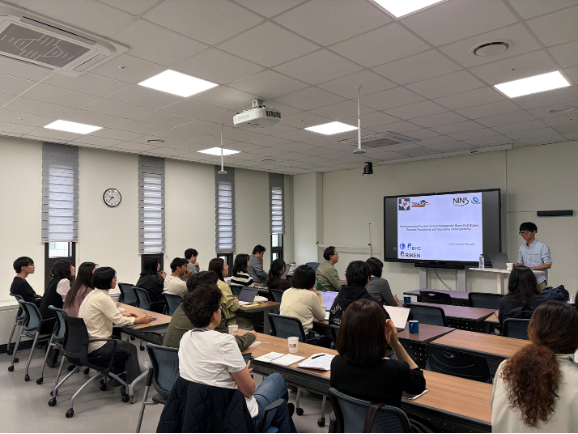
A Reusable Score for Cell States across Datasets
Cell states defined by individual markers can shift across single-cell RNA-sequencing datasets. The team instead assembled recurrent differentially expressed gene sets into state scores and ordered individual cells along a continuum of X, Y, Z, and W states.
This score-based ordering reproduced known marker changes and SSC transitions while quantifying how culture conditions altered population composition. The predicted state mixture could then be compared with colony-forming activity after transplantation.
Reducing Heterogeneity to Separate State from Function
Extrinsic MAPK, mTORC1, and Wnt signals regulate SSC self-renewal and entry into progenitor states. By changing culture conditions, the team generated relatively homogeneous populations enriched for state X or state W, exposing responses that were obscured in mixed cultures.
State-controlled cells retained responsiveness to retinoic acid. Yet enrichment of a molecular state did not always track with regenerative output, showing that transcriptional state and stem-cell function must be evaluated separately.
Why Tunable States Matter
Homogeneous cultures also revealed that the effect of AKT signaling depends on cellular context. The same pathway can produce different consequences for self-renewal or differentiation depending on the starting state and environment.
The work demonstrates that SSC heterogeneity is environmentally tunable rather than fixed. This principle may help explain germline homeostasis and guide culture strategies that preserve SSCs with desired functional properties.
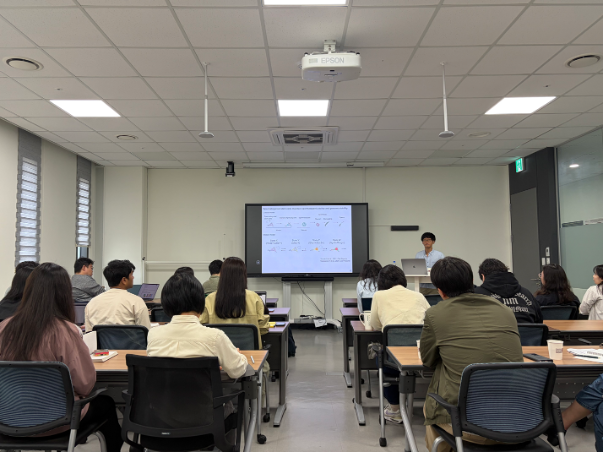
Connecting Single-Cell States with Stem-Cell Function
A transcriptional profile that resembles a stem-cell state does not necessarily mean that a cell can restore spermatogenesis over the long term. In SSC research, transplantation into the testes of an infertile recipient and subsequent formation of donor-derived colonies remains a central functional assay. The team therefore compared state-score predictions directly with transplantation outcomes.
Enrichment of some predicted states correlated with colony-forming activity, but culture conditions could also uncouple molecular state from regenerative capacity. This result cautions against defining SSCs by a marker or single-cell cluster alone. Transcriptional measurements and functional transplantation assays provide complementary evidence and should be interpreted together.
Homogeneous cultures that retained responsiveness to retinoic acid also allowed the researchers to follow the timing of differentiation signals more precisely. Separating the effects of MAPK–AKT, mTORC1, and Wnt signaling by starting state reveals relationships that disappear in population averages. This framework may guide more rational culture conditions for germ-cell preservation and studies of male infertility.
References
Suzuki, S., McCarrey, J. R., & Hermann, B. P. (2021). An mTORC1-dependent switch orchestrates the transition between mouse spermatogonial stem cells and clones of progenitor
spermatogonia. Cell Reports, 34(7), 108752.
Suzuki, S., McCarrey, J. R., & Hermann, B. P. (2021). Differential retinoic acid responsiveness among subsets of mouse late progenitor spermatogonia. Reproduction, 161(6), 645–655.

- 55, Expo-ro, Yuseong-gu, Daejeon, South Korea, 34126 Tel. +82-42-878-8310
Copyright(c) 2022 Center for Genome Engineering Research at IBS. All Rights Reserved.