
Seminars & Events
Highlight
Dr.Chuna Kim (KRIBB) Reveals the Fibrotic Niche Left by Imperfect Repair in the Aging Liver
On April 20, the Center for Genome Engineering at the Institute for Basic Science hosted Dr. Chuna Kim of the Aging Convergence Research Center at the Korea Research Institute of Bioscience and Biotechnology for a seminar titled “Imperfect Repair in Aging: Uncovering the Fibrotic Niche and Metabolic Vulnerability.”
Aging cannot be explained by telomere shortening alone. Senescent cells remain metabolically active after cell-cycle arrest and release a senescence-associated secretory phenotype that alters surrounding tissue. While immune surveillance removes many of these cells in young organisms, unresolved wounds and immune-evasive senescent cells can accumulate with age.
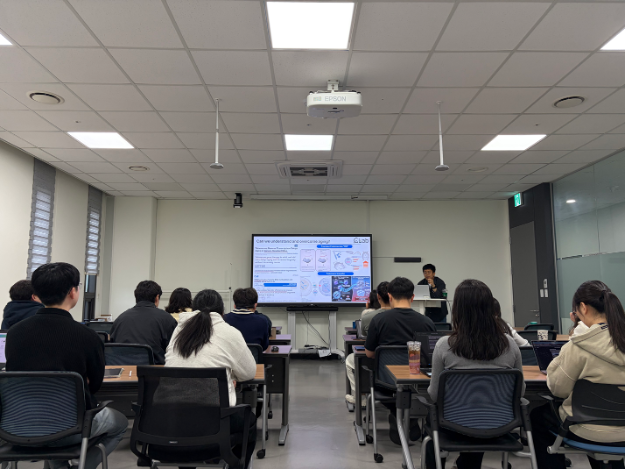
Capturing Rare Fibrotic Regions with FiNi-seq
Because senescent cells are rare, they are often missed by conventional single-cell RNA sequencing. Dr. Kim’s team developed Fibrotic Niche enrichment sequencing, which exploits the resistance of extracellular-matrix-rich regions to enzymatic digestion and selectively enriches the fibrotic niche.
Comparison of young and aged mouse livers revealed strong enrichment of scar-associated populations, including mesenchymal cells and T cells. Combining single-cell transcriptomes with single-nucleus ATAC-seq captured both cellular composition and age-dependent chromatin accessibility.
Endothelial Identity Loss and Immune Exhaustion
Endothelial cells in the aged fibrotic niche lost liver-specific identity and increased inflammatory and innate-immune programs. Wif1- and Smoc1-producing fibroblast populations displayed senescent features and were spatially concentrated around the portal region.
The niche also contained more tissue-resident CD8 T cells with high PD-1 expression. As immune cells become exhausted, ineffective clearance and fibrosis may reinforce one another and spread dysfunction to surrounding tissue.
Targeting a Pathological Ecosystem
Senolytics remove senescent cells, but senescence also contributes to normal wound repair. Dr. Kim proposed viewing aging as an accumulation of imperfectly resolved repair and emphasized the interactions among fibrotic cells, vessels, and immune cells rather than relying on a single marker.
By capturing early pathological niches through their physical properties, FiNi-seq may help identify tissue vulnerability before end-stage fibrosis and reveal preventive targets for chronic liver disease and aging.
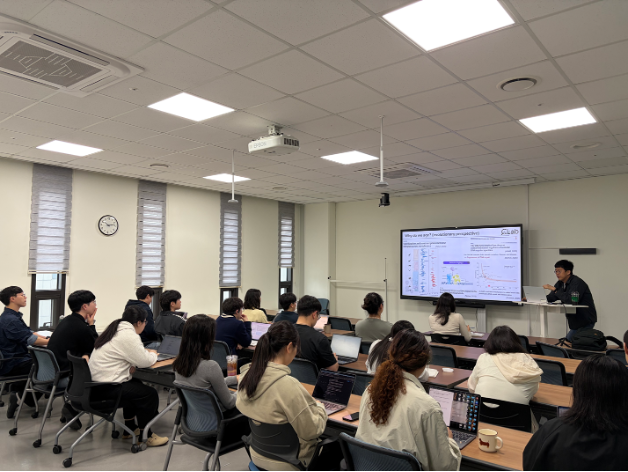
Finding Therapeutic Vulnerabilities in Spatial Aging Signals
A key feature of FiNi-seq is that it begins with the physical trace of fibrosis rather than comparing cell identities only after complete tissue dissociation. Rare populations can be filtered out as statistical noise in conventional analyses. Enriching the damaged region first makes it easier to detect uncommon cells and signaling interactions that may initiate disease.
The team combined transcriptomic and chromatin-accessibility profiles with spatial transcriptomics and imaging to verify where candidate populations reside in intact liver. Fibrotic endothelial cells, Smoc1-positive fibroblasts, and exhausted T cells accumulated around the portal region as a spatially organized ecosystem. This pattern suggests that aging does not advance uniformly across an organ but may begin at vulnerable sites and expand into neighboring tissue.
Dr. Kim explained that combining metabolic vulnerabilities with cell-to-cell signaling could weaken a pathological niche without indiscriminately eliminating every p16-positive cell. If comparable microenvironments can be identified in human chronic liver disease and connected to blood- or imaging-based markers, the approach may eventually help predict risk and define an intervention window before overt fibrosis develops.
References
Kwon, Y. T., et al. (2025). Quasi-spatial single-cell transcriptome based on physical tissue properties defines early aging associated niche in liver. Nature Aging, 5, 929–949.
Kim, J., Kim, M., & Kim, C. (2026). Imperfect repair in aging: Senescent cells and the hepatic fibrotic niche. BMB Reports.

- 55, Expo-ro, Yuseong-gu, Daejeon, South Korea, 34126 Tel. +82-42-878-8310
Copyright(c) 2022 Center for Genome Engineering Research at IBS. All Rights Reserved.