
Seminars & Events
Highlight
Professor Ahmed Morsy Abdal Dayem Presents Growth Factor-Inspired Peptide Strategy to Enhance Stem Cell Therapy
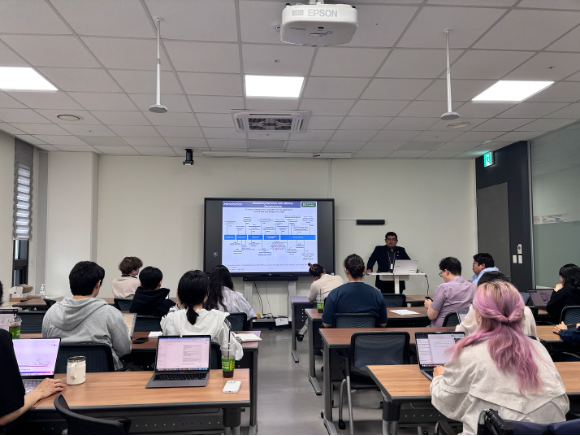
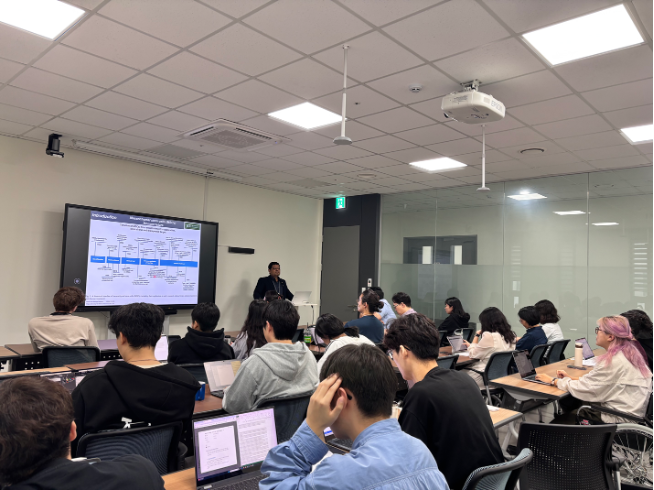
On September 30, the Center for Genome Engineering (CGE) at the Institute for Basic Science hosted Professor Ahmed Morsy Abdal Dayem of Konkuk University for an internal seminar titled “Growth Factor-Inspired Peptide Mimetics: Unlocking Stem Cell Therapeutic Potential.” Professor Ahmed is an Assistant Professor at Konkuk University’s Institute for Advanced Regenerative Science. His research focuses on improving culture environments for mesenchymal and induced pluripotent stem cells and enhancing the therapeutic functions of stem cell-based materials.
The seminar covered the full process from isolating and characterizing stem cells to improving their proliferation, differentiation, and therapeutic activity with short peptides derived from growth factors and extracellular matrix proteins. Professor Ahmed highlighted an approach in which functional peptide sequences are immobilized on culture surfaces as alternatives to full-length growth factors, which are often expensive and less stable.
Obtaining and Characterizing Mesenchymal Stem Cells from Diverse Tissues
Mesenchymal stem cells (MSCs) can be obtained from several tissues, including adipose tissue, bone marrow, and the umbilical cord. Each source requires a carefully optimized isolation procedure. Excessive enzymatic digestion of adipose tissue, for example, may damage the desired cells, while blood contamination should be minimized. Bone marrow-derived MSCs have been widely studied, but their collection involves a relatively invasive and painful procedure.
Professor Ahmed discussed the advantages of Wharton’s jelly-derived MSCs (WJ-MSCs), which originate from young tissue and can be obtained without an invasive procedure. After the blood vessels are avoided and Wharton’s jelly is isolated from the umbilical cord, cells can be collected as they migrate out of the tissue during culture. He also introduced stem cells isolated from orbicularis oculi muscle tissue discarded during ophthalmic surgery, showing how surgical waste tissue can serve as a valuable source of regenerative cells.
Isolated cells must then be characterized before they can be defined as MSCs. This assessment includes their adherence to plastic, surface-marker profile, and ability to differentiate into adipogenic, osteogenic, and chondrogenic lineages. The research team evaluates cell morphology, colony-forming ability, positive and negative surface markers, and multilineage differentiation potential to determine cell identity and quality.
Recreating Protein Functions with Immobilized Peptides
Stem cell behavior is strongly influenced by the surrounding microenvironment. Extracellular matrix proteins and growth factors transmit signals through cell-surface receptors to regulate adhesion, proliferation, differentiation, and aging. Although native and recombinant proteins can provide these signals, they are costly to produce and often difficult to store and standardize. Short peptides that reproduce their functional regions offer greater stability, lower production costs, and easier immobilization on culture surfaces.
The team first demonstrated that peptides derived from fibronectin and fibroblast growth factor 2 (FGF2) could be immobilized on culture plates to support the attachment and proliferation of human pluripotent stem cells. This strategy suggests a route toward chemically defined culture systems with reduced reliance on animal-derived substrates such as Matrigel or costly recombinant proteins.
The researchers subsequently cultured WJ-MSCs on a surface coated with the FGF2-derived peptide FP2 (44-ERGVVSIKGV-53). FP2 increased the phosphorylation of FGFR1 and FRS2α and activated AKT and ERK signaling, improving cell proliferation, colony formation, and osteogenic and chondrogenic differentiation. WJ-MSCs expanded on FP2-coated surfaces also reduced inflammation and promoted osteochondral regeneration after transplantation into a mouse model of osteoarthritis.
Using AI-Based Structural Prediction to Study Peptide–Receptor Binding
Professor Ahmed also emphasized the need to understand how candidate peptides interact with their receptors. His team combined molecular docking and HADDOCK scoring with computational tools such as AlphaFold2 and CABS-dock to predict peptide–receptor interactions. Integrating structural prediction with experimental results can help explain the mechanism of action and support more efficient screening of new peptide candidates.
The seminar demonstrated that the success of stem cell therapy depends not only on the cells themselves but also on the microenvironment in which they are prepared. Peptides that mimic growth factors and extracellular matrix proteins may lower culture costs, improve reproducibility, and strengthen therapeutic functions before transplantation. This approach could provide a practical foundation for standardized stem cell manufacturing and future regenerative medicine applications.
References
Abdal Dayem, A., et al. (2020). The immobilization of fibronectin- and fibroblast growth factor 2-derived peptides on a culture plate supports the attachment and proliferation of
human pluripotent stem cells. Stem Cell Research, 43, 101700.
Abdal Dayem, A., et al. (2023). Bioactive peptides for boosting stem cell culture platform: Methods and applications. Biomedicine & Pharmacotherapy, 160, 114376.
Lee, S. B., et al. (2024). Efficient improvement of the proliferation, differentiation, and anti-arthritic capacity of mesenchymal stem cells by simply culturing on the immobilized
FGF2-derived peptide, 44-ERGVVSIKGV-53. Journal of Advanced Research, 62, 119–141.

- 55, Expo-ro, Yuseong-gu, Daejeon, South Korea, 34126 Tel. +82-42-878-8310
Copyright(c) 2022 Center for Genome Engineering Research at IBS. All Rights Reserved.