
Seminars & Events
Highlight
Dr.Chayasith Uttamapinant Presents Enzyme Tools for CRISPR Diagnostics and PET Bioremediation
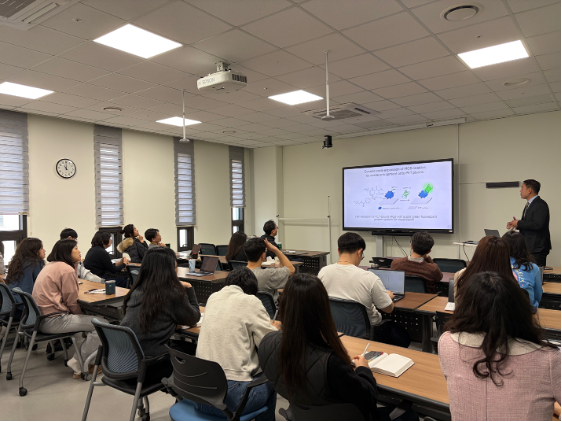
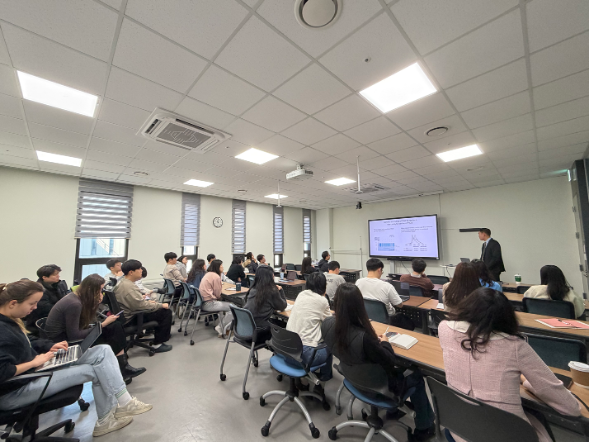
On March 4, the Center for Genome Engineering (CGE) at the Institute for Basic Science hosted Chayasith “Tao” Uttamapinant of the Vidyasirimedhi Institute of Science and Technology (VISTEC), Thailand, for an internal seminar titled “Enzyme Tools for Genetic Detection and Plastic Bioremediation.”
Uttamapinant develops chemical and synthetic biology tools for controlling protein function. After earning his Ph.D. at MIT, he joined Jason Chin’s laboratory at the MRC Laboratory of Molecular Biology, where he worked on genetic code expansion. He joined VISTEC in 2018. His seminar covered two lines of research: CRISPR diagnostics designed for use in Thailand and engineered enzymes for PET plastic degradation and recycling.
Deploying CRISPR Diagnostics for Infectious Diseases in Thailand
CRISPR diagnostics convert the target-dependent nuclease activity of Cas proteins into fluorescent or lateral-flow signals. Uttamapinant’s team carried out large-scale clinical validation of a COVID-19 CRISPR diagnostic, developed multiplexed differentiation of SARS-CoV-2 variants, and obtained Thai FDA approval. The platform was subsequently extended to melioidosis, an infection caused by the environmental bacterium Burkholderia pseudomallei.
Melioidosis is endemic in Southeast Asia, yet rapid molecular diagnosis can be difficult in resource-limited settings. The CRISPR-BP34 assay was clinically benchmarked for sensitivity and specificity and may also support environmental surveillance of B. pseudomallei in water sources.
Uttamapinant also emphasized sustainable local production. Domestic production of recombinase polymerase amplification (RPA) reagents and the use of premixed or freeze-dried formats could lower costs and reduce dependence on imported cold-chain materials.
How Phase Separation Accelerates RPA
The team found that RPA does not occur solely in a uniform solution. Its protein and nucleic-acid components organize into droplets through liquid–liquid phase separation. The recombinase UvsX and single-stranded DNA-binding protein Gp32 can each form dynamic condensates.
Direct fluorescence imaging of recombination and DNA synthesis showed that UvsX acts as the principal organizer of RPA droplets. The spatial segregation of UvsX and Bsu polymerase was linked to efficient amplification; without phase separation, the polymerase could inhibit the strand-displacement activity of UvsX.
These results suggest that a phase diagram describing component concentration and condensate organization can guide the design of faster and more reproducible RPA–CRISPR diagnostics. Spatial organization therefore becomes an engineering parameter alongside enzyme concentration.
Discovering the PET Hydrolase MG8 in the Human Saliva Metagenome
The second part of the seminar focused on biological degradation and valorization of polyethylene terephthalate (PET). By mining metagenomic datasets for enzymes active under moderate conditions, the researchers discovered MG8 in the human saliva metagenome.
Structure analysis and molecular simulations guided the selection of loop regions for engineering, while a mass-spectrometry-based high-throughput assay identified improved variants. Engineered MG8, including the G127Y/F250A double mutant, outperformed other engineered PET hydrolases under specific high-salt, mesophilic conditions and retained strong activity when secreted from cells.
The team is connecting PET hydrolysis with chemical, enzymatic, and whole-cell pathways that convert the products into higher-value materials. They also used genetic code expansion to replace the catalytic serine of MG8 with the noncanonical amino acid DAP, creating a covalent interaction with PET. This strategy may stabilize enzyme contact with a solid polymer surface and support PET biofunctionalization.
The seminar demonstrated how engineering the spatial organization and substrate binding of enzymes can address practical challenges in diagnostics and environmental remediation. Local CRISPR reagent production and enzyme-based PET recycling illustrate how precise molecular tools can be translated into broadly useful technologies.
Turning Molecular Tools into Deployable Technologies
A CRISPR diagnostic must address more than analytical sensitivity before it can be used in the field. Reagent cost, storage stability, contamination control, and an easily interpreted readout all matter. Uttamapinant’s team placed RPA amplification upstream of Cas13 and designed guide RNAs and fluorescent signals to distinguish several targets in one test. Such multiplexing is particularly valuable for rapidly changing viral variants and locally important infections such as melioidosis.
The phase-separation work showed why an RPA reaction cannot be understood simply by mixing proteins at fixed concentrations. Enzymes and DNA move into and out of condensates formed by UvsX and Gp32, while the position of the polymerase affects amplification kinetics. Mapping this organization offers a systematic way to identify formulations that produce rapid, robust reactions with smaller amounts of reagent.
The PET project applied a similar engineering logic. Structural analysis and loop dynamics guided MG8 mutagenesis, and mass-spectrometry-based screening enabled rapid comparison of degradation performance. Introducing a noncanonical amino acid that forms a covalent interaction with PET may improve contact with the substrate and enable new forms of plastic-surface functionalization. The seminar illustrated how precise molecular design can advance both deployable diagnostics and circular-material technologies.
References
Eiamthong, B., et al. (2022). Discovery and genetic code expansion of a polyethylene terephthalate (PET) hydrolase from the human saliva metagenome for the degradation and
bio-functionalization of PET. Angewandte Chemie International Edition, 61(37), e202203061.
Patchsung, M., et al. (2023). A multiplexed Cas13-based assay with point-of-care attributes for simultaneous COVID-19 diagnosis and variant surveillance. The CRISPR Journal, 6,
99–115.
Pakdeerat, S., et al. (2024). Benchmarking CRISPR-BP34 for point-of-care melioidosis detection in low-income and middle-income countries: A molecular diagnostics study. The
Lancet Microbe, 5(4), e379–e389.
Homchan, A., et al. (2025). Recombinase-controlled multiphase condensates accelerate nucleic acid amplification and CRISPR-based diagnostics. Journal of the American Chemical Society, 147(12), 10088–10103.

- 55, Expo-ro, Yuseong-gu, Daejeon, South Korea, 34126 Tel. +82-42-878-8310
Copyright(c) 2022 Center for Genome Engineering Research at IBS. All Rights Reserved.